
The roles and responsibilities of players in football have significantly evolved over the last decade. The most fascinating aspects of the game revolve around differing philosophies in coaching such as profiling of players and playing to their strengths. There are nuances in each system and subsequently in each position that a player is assigned to, which differs based on the manager’s preferred style of play or the strengths that the player possesses or both. This series will be delving into such nuances that further enhance perspectives of the game and the profiles of the players involved.
A full-back’s role in the modern game has been a point of discussion for quite some time. As opposed to only a decade ago, some of the best teams in the world use their full-backs in variety of ways that best compliment the manager’s philosophy. Reece James, Joao Cancelo, Giovanni Di Lorenzo and Dani Carvajal can all be considered exceptional full-backs for their respective teams but they play different roles and possess different strengths to the point that comparisons between them almost do not feel fair. Much like varying profiles of forwards and midfielders, a role of a fullback is also evolving and becoming more diverse as the game moves forward. This not only makes the analysis of the game more interesting but also adds a level of complexity for the opponents to anticipate.
Having had an allegiance towards Manchester United for well over a decade now, I’ve chosen fullbacks Diogo Dalot and Tyrell Malacia at Manchester United and their performance against Southampton as the subject of my first analysis on the role of a fullback in the modern game. Erik Ten Hag’s introduction at Manchester United is rather reminiscent of the chaos that has generally been associated with the club over the past nine years. Following back-to-back losses to Brighton and Brentford, Ten Hag welcomed a more pragmatic approach towards preparing his team as he set out to find the best combination of players to instill his style of play at Manchester United.
Tactical Setup: Manchester United and Southampton
Against Southampton, Manchester set-up in a familiar 4-2-3-1 with Diogo Dalot at right back and Tyrell Malacia at left back. Ten Hag chose to go with the same line-up of players that won against Liverpool, with a similar set-up as opposed to opting for a 4-3-3 in the first two games of the season. Southampton, on the other hand, set-up in a fluid 4-2-2-2 system with the sole purpose of isolating United’s build up from the wide areas. Having had a successful outing at Leicester City in the previous game week, Southampton aimed to capitalize on Man United’s shaky start to the season. However, United had just come off the back of their first league win against Liverpool since 2018.

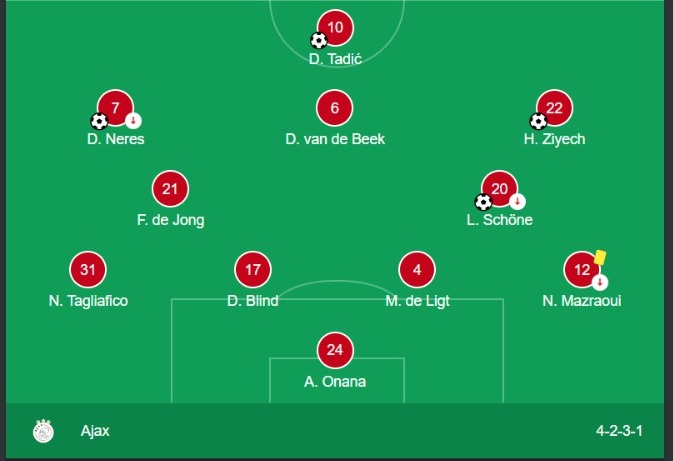
At Ajax, Erik Ten Hag was known for his tactical flexibility around his approach towards accommodating his squad’s strength. In 2018/19 season, during Ajax’s infamous run in the Champions League, Ten Hag opted for a 4-3-3/4-2-3-1 hybrid with Tadic as the false-nine as his primary set-up in the champions league. The system incorporated the strengths of players such as Frenkie De Jong’s ball-carrying from the 1st phase of play and Matheus De Ligt and Daley Blind’s ball-playing abilities as a centre-back pairing. However, one of the key aspects of Ten Hag’s system at Ajax was how the full backs were used on a game-to-game basis with Mazraoui and Tagliafico as two stylistically different profiles of full-back. While Tagliafico seemed the more explosive full-back and was largely instructed to provide the width on the left-hand side, Mazraoui was the one responsible for tucking into midfield and adding an extra man between the lines. At Manchester United, we saw a similar pattern of movements between Diogo Dalot and Tyrell Malacia.
Build-up Shape
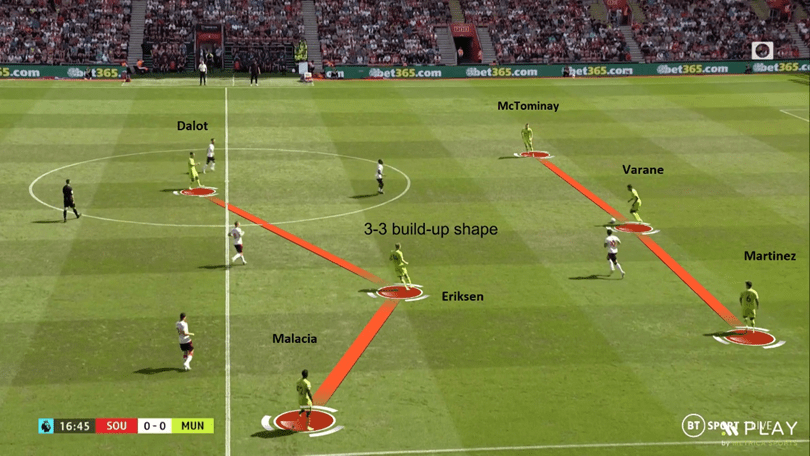
From the get go, Manchester United set up in a 3-1 buildup shape within the first 5 minutes. Malacia tucked in next to Martinez and Varane while one of McTominay or Eriksen were responsible for moving the ball from the 1st to the 2nd phase of play.

Over the course of the first half, Man Utd were flexible in their process of build-up but largely reverted to 3-1 or 3-3 shape to move the ball through midfield. However, Southampton made it significantly difficult for them to do so. During this period, there were clear identical patterns of ball-progression that saw Malacia become part of the back three in the 3-1 shape whereas whenever United reverted to a very narrow 3-3 shape, both Dalot and Malacia flanked Eriksen in the midfield 3. This is when the players showed signs of understanding zonal responsibilities. This was also a period where Manchester United dominated possession and threatened Southampton each time they received the ball in the attacking-third.
Inverted full-backs, half spaces and steering wheels.
Another significant pattern of progression for United was the usage of the fullbacks in half spaces. In the following clip, you will see how narrow and inverted the distance between Malacia and Dalot is as United create their first (half) chance under the 10-minute mark. In this phase of play, Malacia underlaps into the half-space as the ball is passed towards the right-flank. Dalot does well to beat his man, but his cross is too high for Bruno Fernandes to head it in.
It is clear from his time at Ajax, that Erik Ten Hag prefers his wingers to provide width while the midfielders and/or the full-backs are responsible for occupying and attacking through the half-spaces. Manchester United’s full-backs are not quite the same profiles as the ones at Ajax but their technical quality on the ball means that they would attempt to fill those roles. Unlike when they faced Liverpool, Manchester United had a lot of possession in the first 45 minutes of the game against Southamption and it is was therefore important for the players to be patient in build-up. In order to do so, players needed to understand positional and zonal responsibilities and only then could they successfully switch roles with each other. Manchester United as a team showed clear signs of understanding of their zonal responsibilities. For instance, in the following clip, Dalot inverts and moves as narrow as possible covering the zones usually occupied by McTominay or Eriksen. Similarly, Malacia moves into the half-space that you would expect Bruno Fernandes, Sancho or Rashford to occupy. In doing so, Manchester United created half a chance, with as many bodies in the box as possible.
Similarly, in yet another phase of possession, Manchester United create an even better opportunity where this time its Malacia who has moved into midfield that leads to a very good chance from an Eriksen cross. In this situation both Eriksen and Malacia switch positions as part of the build-up.
Ten Hag also seems to show his ‘Cruyff’-ian roots when he echoes a very basic but effective tactic of using his full-backs as a “steering wheel”. As best described by Netherland’s manager Louis Van Gaal in the following quote :
This is best represented in the following clip where Dalot makes a run into the half-space while Malacia stays back. When Dalot receives the ball, he isn’t able to control it and Southampton attempt to counter-attack. This is where Malacia, as an extra man in defense, comes in and breaks the play.
An almost successful culmination of these patterns in play was best depicted in the 19th minute of the first half when Manchester United created a flurry of chances worth a total of 1.00 xG. In the following clip, when the ball is with Rashford on the left flank, Malacia does not over or underlap and stays as narrow as he can. As the ball is switched, United players overload on the right hand-side including Malacia who is practically in the middle of the pitch in an inverted role. In this process, Dalot makes use of room he finds in the half-space and puts in a cross that opens the floodgate to a number of chances. Manchester United were unlucky to not score in this phase of play as the build-up and execution including the cross by Dalot was very well done.
The Goal
Ultimately, Erik Ten Hag’s use of full-backs in an inverted/narrow position and in the half-space acted as a contributing factor to Manchester United’s winner against Southampton. The team’s use of possession at overloading one side before switching it to the other side is a common trope used by managers such as Pep Guardiola, Mauricio Sarri and Louis Van Gaal. Erik Ten Hag prefers his wingers to provide the width and stretch the line of defense and create spaces for runners to exploit in. Typically, the runners in this scenario are midfielders however, Ten Hag also prefers his full-backs to attack those spaces and create chances while also having as many players in the attacking box as possible. For Manchester United’s winner against Southampton, we saw them executing a fraction of such a philosophy. The ball was received wide by Elanga who was providin width on the right hand-side, while the right-back Diogo Dalot occupied the forward half-space. This, along with Elanga’s ball carrying, created space for Dalot in the wide areas which led to the goal by Bruno Fernandes.
Not only is this a brilliant execution of a full-back exploiting the half-space but it is also a great example of Manchester United players being aware of their positional and zonal responsibilities. This is because Dalot occupies the half space when Elanga has the ball out wide, however when Elanga carries the ball inside, Dalot switches position, goes out wide and subsequently makes the assist for the goal.
Erik Ten Hag is an exciting manager with suprising hints of pragmatism to his approach in coaching as compared to his contemporaries in the Premier League and in Netherlands. The Dutchman’s use of fullbacks raises an interesting comparison to philosophies of the past as well as the present and there is no doubt about the fact that Manchester United will evolve stylistically under Erik Ten Hag. With the Premier League having turned into a giant entity when it comes to hosting some of the best talents in Football,(coaches and players alike) there is bound to be fascinating use of varying profiles of full-backs in different teams.
Analysis Software: Metrica Sports
 Behind the Lines